
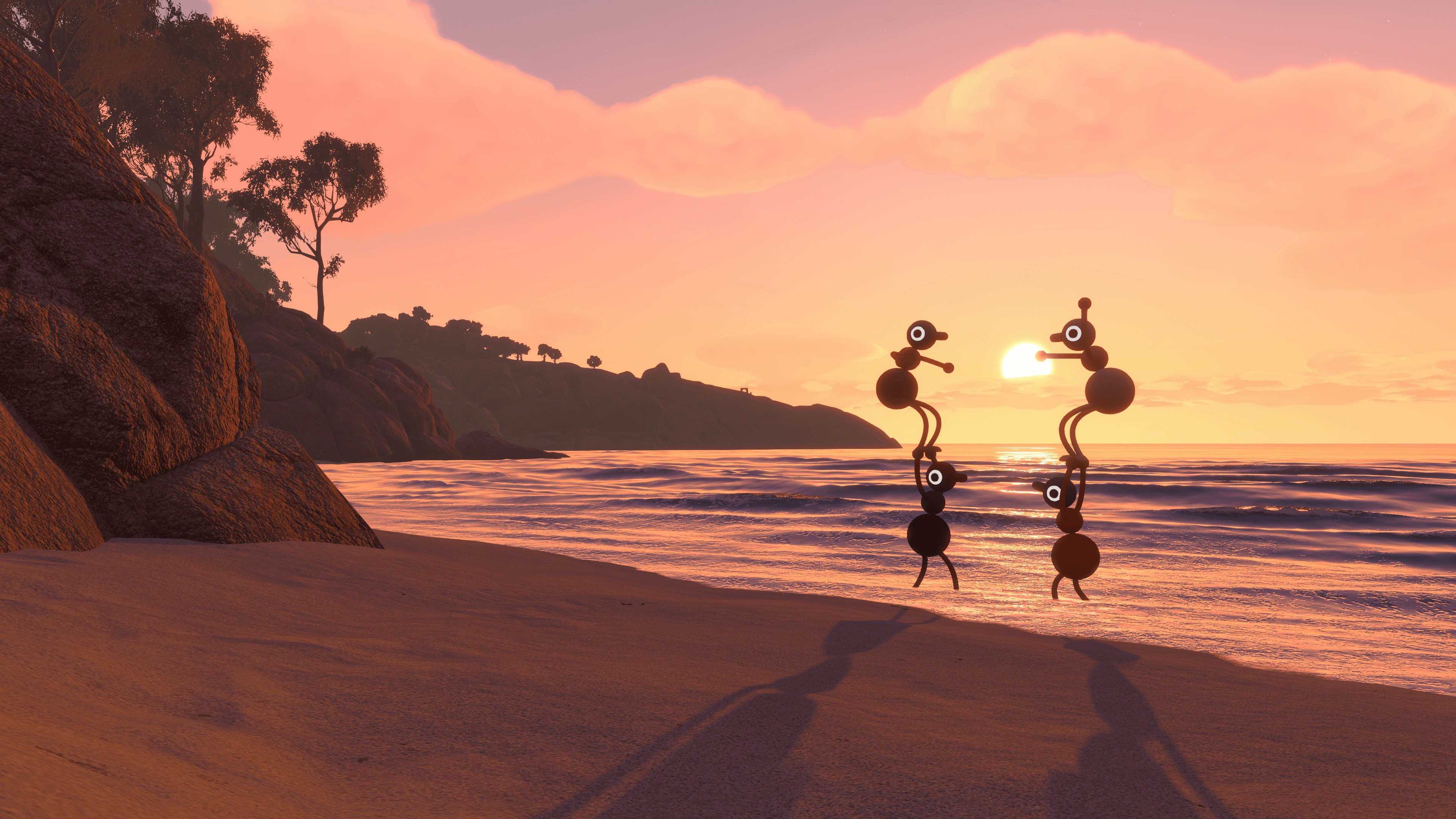
Big Walk is worth considering if you have friends or family who want to explore, communicate, and solve puzzles together. Its best ideas are built around proximity voice chat, shared vocabulary, and the small stories that happen while a group finds its way. It is a poor fit for solo players, public-matchmaking seekers, or players who want fast travel and constant direction. The group is part of the purchase.
What Is Big Walk?
Big Walk is a cooperative multiplayer adventure from House House, published by Panic. The official game is built for online groups of 2–12 players across PC, Mac, PlayStation 5, and Switch 2, with crossplay support listed among its core features. There is no solo mode, so the game does not treat companionship as a bonus on top of a normal campaign. Your party, its habits, and the language it invents together are central to how the world works.
The premise is deliberately open. Players learn movement and communication tools before heading into an island filled with landmarks, structures, and puzzles. Traditional quest markers are not the main wayfinding system, so the world asks a group to observe, test, describe, and remember. A session can feel like visiting a strange place with friends.
Communication Is the Real Puzzle
Big Walk’s most distinctive mechanic is its proximity-based voice chat. Voices can become muffled when someone is behind a wall, echo in a large tunnel, or disappear when a player wanders too far away. That turns distance into a gameplay rule: the group is not simply talking over an external call while completing objectives, because being able to hear the right person at the right moment is part of the problem.
The result is a type of cooperation that many multiplayer games only suggest. A player may describe a shape, relay a sound, guide someone who cannot see, or coordinate a timed action from a distant platform. Groups can create gestures, shorthand names, and private cues. This shared language makes communication feel like progression rather than a separate feature.
The game’s tools support that process without removing the need to work together. Walkie-talkies, flashlights, loudspeakers, maps, and other equipment can change how a group searches, while limited carrying space makes preparation collaborative. A separate voice call may keep the game playable, but reviewers argue that bypassing proximity chat removes an important part of what makes Big Walk unusual.
Puzzles, Exploration, and Progression
The puzzles are distributed across the island and use several kinds of cooperation. Some ask players to act side by side, manipulate objects, or line up a sequence. Others split the group across distance, require synchronized timing, or limit what one player can see and communicate. The research also describes platforming, throwing, visual descriptions, musical sounds, and obstacle-course guidance.
Big Walk does not present these challenges as a simple staircase from easy to hard. Because groups can discover activities in different orders, difficulty is shaped by curiosity, team habits, and the way a group interprets each space. Review material describes the puzzles as demanding without being cruel, while groups can divide roles, test ideas, and rotate who is currently confused.
Exploration between puzzles is part of the experience rather than empty time between levels. Beaches, hills, tunnels, buildings, the day-night cycle, and distant landmarks create room for accidental stories. Reviewers describe getting lost, searching for dropped equipment, or finding a friend by following a flare. These moments explain why slow movement can be memorable for one group and frustrating for another.
Progression is expressed through discoveries and unlocks rather than a dense interface. Groups can carry objects to structures, earn keys, and open useful ways to travel or interact with the island. This spoiler-light review will not list the full solution path; Big Walk gives a party reasons to remember what it has learned and apply shared terms again.
How Many People Should Play Big Walk?
Officially, Big Walk supports 2–12 players, and the research indicates that puzzle setups can adjust for different group sizes. Two people can make every instruction and mistake easy to notice, while larger groups can divide tasks and create more lively confusion. Several reviewers and community discussions suggest that four to six players may be a particularly comfortable range, but that is a recommendation based on experience, not an official requirement.
The more important question is whether your group enjoys this cooperation. Big Walk asks players to speak clearly, listen, recover from wrong guesses, and sometimes become separated. It suits friends who enjoy inside jokes and solving a problem together, but not a group that wants a public lobby, independent play, or marked objectives.
The Biggest Problems to Know Before Buying
The largest structural limitation is the lack of solo play and public matchmaking. You need to bring your own group and have that group available at roughly the same time. If friends want to continue without the original host, the save is tied to the player who initially hosted the session. Current behavior should be checked against the latest official information.
Travel speed is another consideration. Big Walk leaves space between locations and does not rely on fast travel as the default solution. A video review describes the expected journey as shorter than the eventual experience because exploration, detours, and conversation expand the time naturally. That pacing may appeal to relaxed groups and frustrate players who want constant action.
Player feedback also reports connection problems, synchronization issues, audio-setting frustrations, occasional finicky movement, and moments where a character can become stuck. These are individual reports, not universal conditions. Their current frequency and patch status are To be confirmed at publication, because technical issues and settings can change after updates. Groups with low tolerance for online friction should check recent platform feedback before buying.
Who Should Buy or Skip Big Walk?
Buy Big Walk if you have a reliable group, enjoy communication-led puzzles, and want a game that creates stories between its formal challenges. It is especially promising for players who like exploring without a constant stream of markers, inventing names for unfamiliar objects, and learning how their friends think. The game’s strongest value is social and experiential rather than competitive or collectible.
Skip it, or wait for more information, if you need a solo campaign, public matchmaking, fast travel, or a highly directed pace. Be cautious if your group will not use proximity voice chat, because several distinctive challenges are designed around relaying information under constraints. If your group is split on slow exploration or online reliability, the purchase decision is To be confirmed until you check current platform reports.
Final Verdict
Big Walk is a good recommendation for a prepared group, not a universal recommendation for every multiplayer player. Its puzzles turn communication into a real mechanic, and its open island makes room for shared language, mistakes, detours, and moments that could not be planned in advance. The trade-off is equally clear: no solo mode, no public matchmaking, host-linked progress, slow travel, and some player-reported technical friction.
If you already know who you will play with and that group wants to use the game’s communication rules, Big Walk is worth putting on your shortlist. Check the current platform price before buying, and use the How Long to Beat guide to decide whether its pace fits your schedule.
Sources and Review Method
This article synthesizes the official Big Walk website and FAQ, identified IGN and GameSpot reviews, the supplied video research, Steam feedback, and the supplied Metacritic roundup. Big Walk Guide has not claimed an independent full playthrough, so no editorial score or site-owned completion time is presented. Current prices, review totals, player counts, connection reports, and patch status must be checked again when published.